
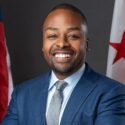
Council Member Zachary Parker
Issue Area Rank
Worker’s Rights Champion
Economic Justice Champion
Environmental Justice Mixed Record
Electoral Justice: DC4D works in coalition to dismantle barriers to voter participation. We believe small, grassroots donors should have more power in our elections than corporate interests, and no one should win office with a minority of the vote.
Zachary Parker’s votes on issues of electoral justice:
Used Fair Elections public financing in most recent election
Voted to fund the implementation of Ranked Choice Voting starting in 2026
Voted for amendment to delay implementation of Ranked Choice Voting to 2028
Housing Justice: Housing is a human right. Too many DC residents, especially Black and brown residents, live in substandard conditions and yet pay more than half their income for rent. DC should ensure all residents have access to decent affordable housing. Ending long-term homelessness is an important first step in ending all forms of homelessness and housing injustice.
Zachary Parker’s votes on issue of housing justice:
Supported capping rent hikes at 5% for rent-controlled units in 2023 and 2024
Did NOT vote to maintain tenant purchase rights in new downtown office-to-housing conversions
Signed on to Green New Deal for Housing legislation
Voted to make it harder to qualify for Emergency Rental Assistance
Did not vote to maintain a 30-day period before eviction can be filed.
Voted to protect tenant purchase (TOPA) rights in 2025 RENTAL ACT
Community Safety: The safest communities are ones where everyone’s needs are met. Only by broadening our understanding of safety will allow us to make sustainable progress toward a District in which fewer people experience and then perpetrate harm. This work should center on meeting the needs of people most at risk of violence.
Zachary Parker’s votes on community safety:
Voted for the penalty-focused crime emergency bill in 2023
Did not sign on to the Metro Safety Act with increased and harsh penalties for fare evasion
Signed on to the ERASE Act to greatly limit solitary confinement at the DC Jail
Did not sign on to the FRESH STARTS Act to improve the quality of food at the DC Jail
Did not vote for an amendment to reduce use of pre-trial detention in the Peace DC Act
Voted to limit powers of Special Police Officers in public transit in the Peace DC Act
Did not vote for the Residential Tranquility Act that limits First Amendment protest rights
Supported amendment to Secure DC Act to prevent expanding DNA collection to people merely arrested for a felony.
Supported amendment to Secure DC act to speed up implementation of law to enable criminal record sealing and expungement.
Signed on to a bill to prevent MPD from cooperating with ICE/federal immigration enforcement without a judicial warrant.
Education: Educational success shouldn't be defined by the ward we live in. Neighborhood public schools are the foundation of a strong school system and should be protected against privatization. Learning and equity begin at birth, and we should follow student leadership when it comes to school safety and priorities.
Zachary Parker’s votes on education:
Signed on to legislation to make school meals free to all students
Signed on to legislation to make out-of-school time programs available to all students who want it
Workers’ Rights: Workers’ rights are civil rights. Living wages, economic justice, and accountability from businesses are part of how we create a fair and just future for everyone in DC. Every worker should be protected by human rights, health and safety laws.
Zachary Parker’s votes on worker’s rights:
Voted to ensure domestic workers are covered by DC labor laws for wages and safety
Voted against amendment to to reduce base wages for tipped workers to $8/hour
Voted against amendment to cap the minimum wage for tipped workers at 75% of the full minimum wage, which reversed the Initiative 82 requirement to raise the tipped minimum wage to the full minimum wage
Introduced legislation to raise wages for participants in the Summer Youth Employment Program.
Economic Justice: This category addresses whether the Councilmember fought for policies to reduce income and racial inequality, and whether they supported tax increases on high-income residents
Zachary Parker’s votes on economic justice:
Signed on to legislation to create a Child Tax Credit
Voted to raise capital gains tax rates in FY2026 budget
Voted for the RFK Stadium deal, the largest stadium subsidy in U.S. history
Voted to de-couple from federal tax cuts and use savings to create a Child Tax Credit and expand DC’s Earned Income Tax Credit
NOTE: These votes generally show a lack of mixed record on economic justice. However, Parker also led an effort in 2023 to maintain an expiring commercial deed tax, which would have generated funds to fund a child tax credit and tax increase. That amendment never came to a vote, due to lack of support, and thus is not reflected in this tracker. With this added information, DC4D ranks Parker as a champion of economic justice.
Environmental Justice: Climate change, global warming, and an endangered environment have impacts in every system of existence. Government and corporate greed have systematically and adversely infringed on the sanctity of our planet and our neighbors in vulnerable communities. Mitigating the climate disaster with stringent advocacy is how we care for our communities.
Zachary Parker’s votes on environmental justice:
Signed on to Green New Deal for Housing Act
Signed on to Healthy Homes Act to help residents with low-incomes electrify their home
Signed on to the Recycling Refund and Litter Reduction Act (aka, the Bottle Bill)
Voted for the Sensible Pool Building Emergency Declaration to waive Green Building Act standards for a new pool
Introduced legislation requiring a “cumulative impact statement” to prevent environmentally harmful projects in already overburdened communities
Issue Area Rank
Electoral Justice Mixed Record
Housing Mixed Record
Community Safety Champion
Education Champion
Ward 5 Scorecard
Party: Democrat
First Elected: 2022
Used Public Financing in last election: Yes
Endorsements by DC4D in the last race? Yes, 2022
Overview: The DC4D scorecard assesses a DC Councilmember’s commitment to economic, racial, and social justice. The scorecard is broken into issue areas, and within each issue area, members are ranked based on their support for bills that would advance justice, as well as their opposition to bills that would widen racial or economic inequity.