
Economic Justice
This category addresses whether the Councilmember fought for policies to reduce income inequality, including efforts to have high-income residents shoulder a more equitable share of the tax burden. Other specific aspects of economic justice, such as housing or workers’ rights, are covered in other issue papers.
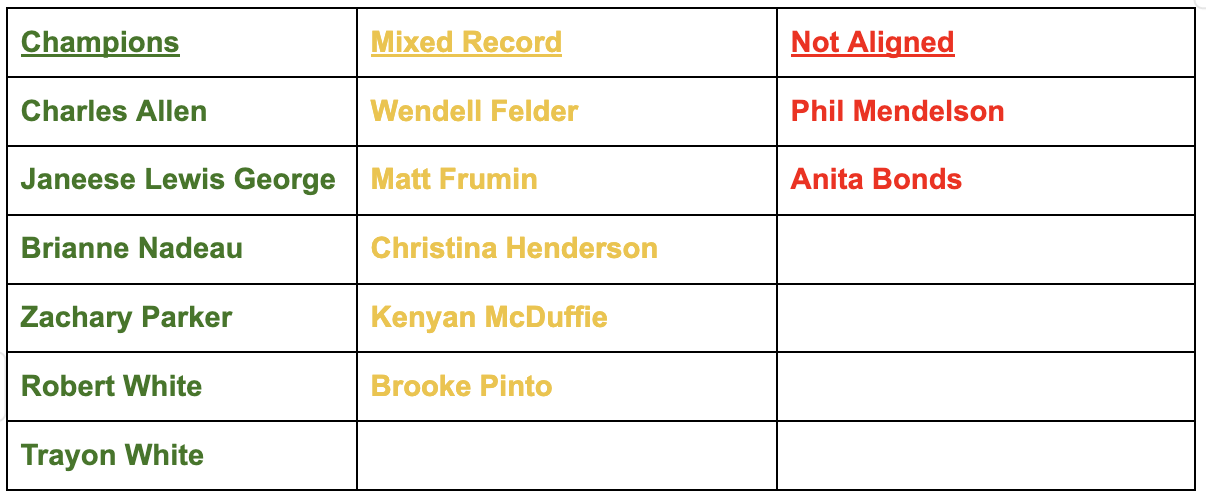
OVERALL RANKING OF DC Councilmembers on Economic Justice
Green = Champion Yellow = Mixed Record Red = Not Aligned with DC4D
SPECIFIC VOTES CONSIDERED
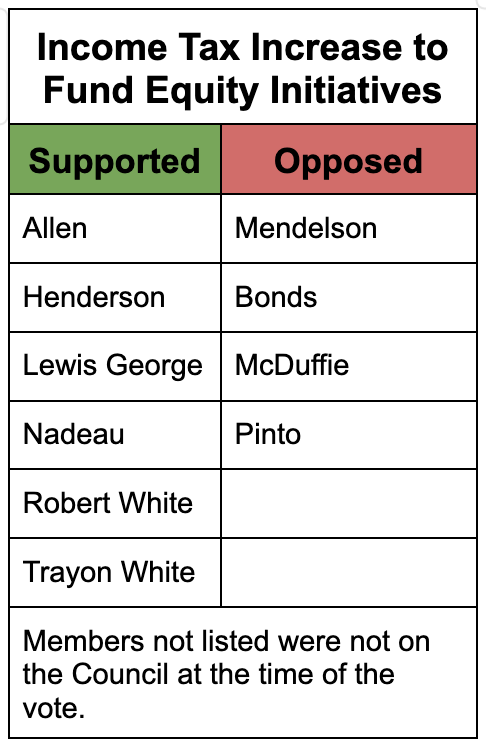
Did They Support the Income Tax Fairness Amendment Act of 2021? In 2021, as part of the FY 2022 Budget Support Act,the DC Council adopted an income tax increase targeting high-income residents – 92% of the increase was paid by millionaires – in order to fund several important priorities. The funds raised were used to increase salaries for childcare teachers and assistant teachers, to provide permanent housing to 2,000 families and individuals experiencing homelessness, and to expand DC’s Earned Income Tax Credit for workers with low incomes. DC for Democracy supported this budget amendment, and the scoring below reflects those who voted for it and those who did not.
DC for Democracy supported the tax increase.
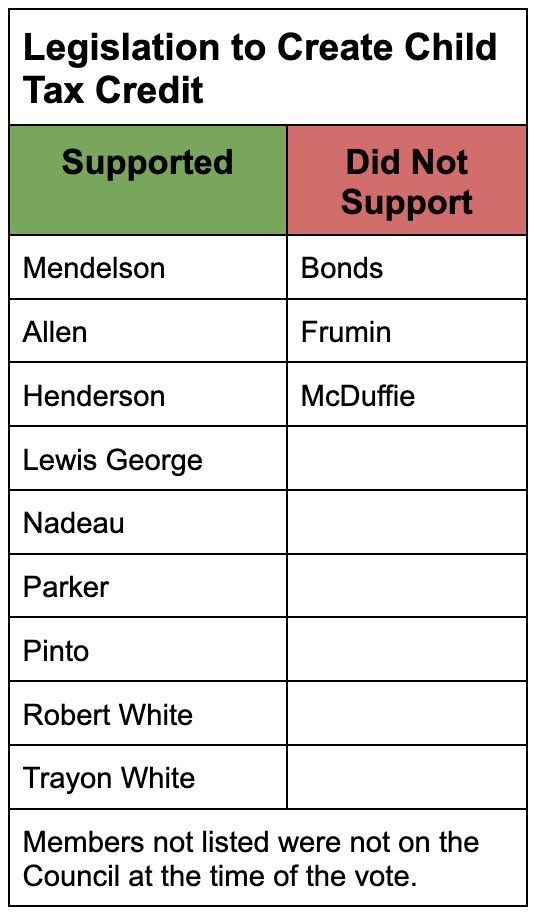
Did they introduce or co-introduce the District Child Tax Credit Act? One of the most effective ways to support families with children and address economic inequality is through a Child Tax Credit, which provides a flat amount per child to families through a tax refund. Nationally, a one-year expansion of the federal Child Tax Credit reduced child poverty by more than 40 percent in 2021, but unfortunately Congress didn’t make the increase permanent. In the wake of that failure, DC and many states have considered creating their own Child Tax Credit. Council Member Parker introduced the District Child Tax Credit Act in 2023, and the scoring below reflects those who signed on as co-introducers and those who did not. (In 2024, a reduced version of this proposal was included by the Council in the budget and unanimously supported, but then was eliminated in the FY 2026 budget.)
DC for Democracy supported the Child Tax Credit bill.
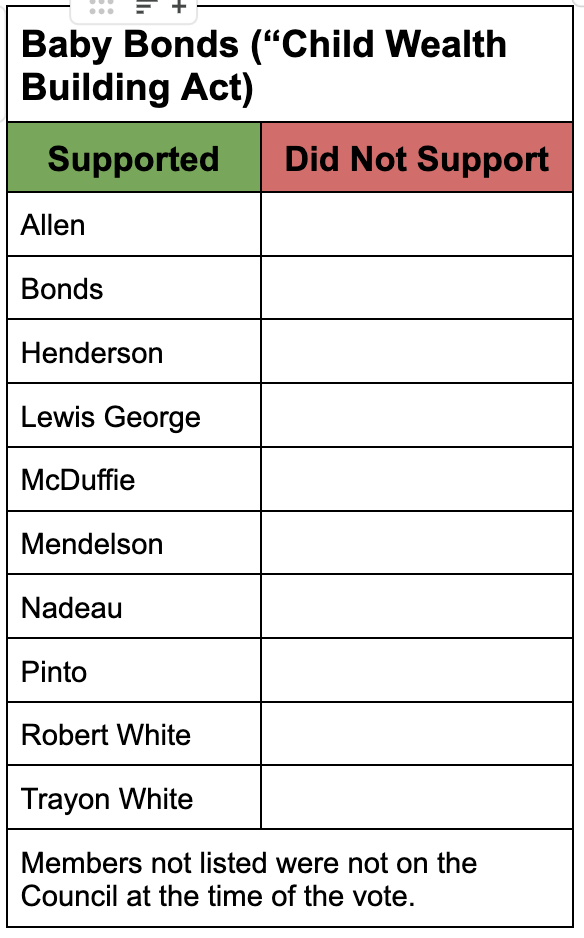
Did they vote to create Baby Bonds in DC? The gap in wealth in DC is even wider than the gap in income. In the DC region, the average assets of white households is 81 times that of Black households. And in DC, the top 0.4% of households hold nearly half of the wealth in DC. Baby Bonds is an approach that helps address the wealth gap. Under the basic Baby Bonds approach, funds are set aside in a trust account for children in low-income families and made available to them when they become an adult. The DC Child Wealth Building Act of 2021 sets aside $1,000 a year until an eligible child is 18, and can be used to start a business or acquire property. The Act was approved and funded as reflected in the table below, but funding was removed in the FY 2026 budget.
DC for Democracy supported the Child Wealth Building Act.
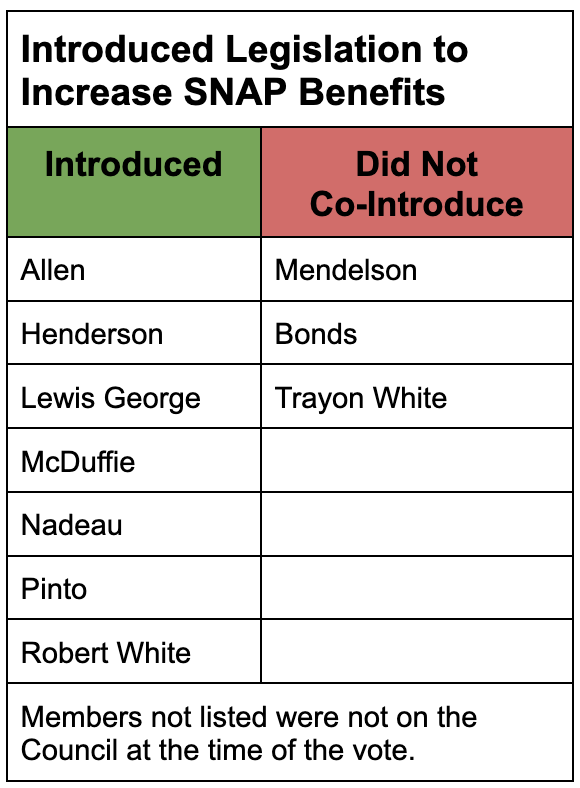
Did they Introduce the Bill to Give SNAP a Raise in 2022? Food insecurity affects one out of every 11 DC residents, and high food prices put a large strain on residents with low and moderate incomes. The federal SNAP program is an effective way to help ensure adequate access to healthy food, but SNAP benefits are too low to fully fund an adequate diet. Many SNAP recipients run out of food before the end of the month. The DC Council considered legislation to increase SNAP benefits using local funds, with the increase equal to about $80 a month for a family of three. The DC Council Office on Racial Equity concluded that this legislation would improve food security for Black residents and other people of color. The scoring below reflects those who signed on to the bill and those who didn’t. (It ultimately passed the Council and then was funded for one-year as part of the DC budget, but it was not continued in 2025.)
DC for Democracy supported the Give SNAP a Raise Act.
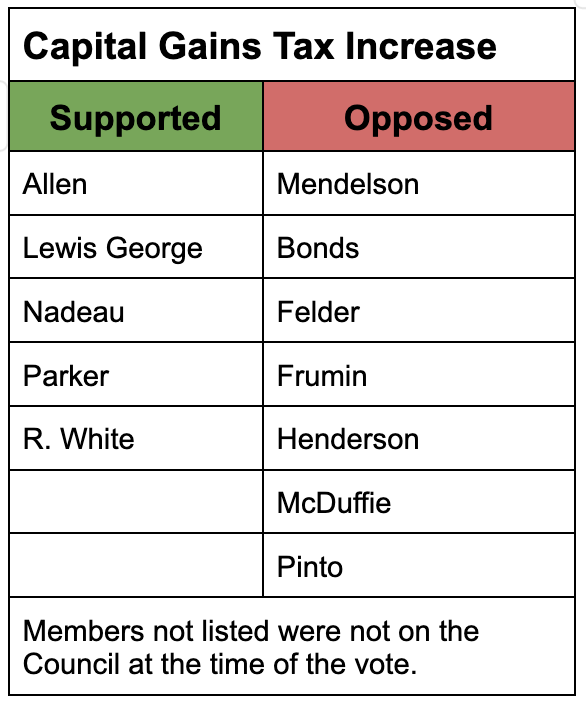
Did they Support Capital Gains Tax Increase in FY 2026 Budget? DC’s tax system taxes our most wealthy residents at about the same rate as middle-income residents, when all taxes are considered. One reason for this situation is that DC has not adopted direct methods to increase taxes on wealth in ways that would target those with the highest incomes. During the FY 2026 budget debate, Council Member Parker proposed an amendment to increase the tax rate on capital gains income, which accrues primarily to those with very high incomes. The amendment also would have closed a loophole used by high-income residents to reduce their income tax. The additional revenue would have been used to restore the Child Tax Credit that had been cut in the proposed FY 2026 budget, and to fund other initiatives that address economic inequity. The scoring below reflects those who voted for the amendment and those who didn’t.
DC for Democracy supported the capital gains tax amendment.
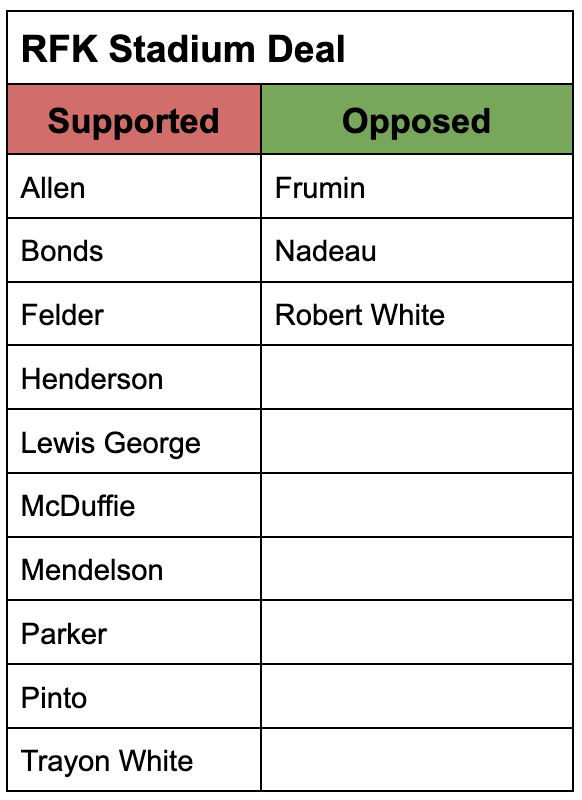
Did they Vote for the RFK Stadium Deal? The legislation to support bringing an NFL stadium to RFK included over $1 billion in direct subsidies (2nd largest in U.S. history); gave the team the right to develop commercial land beyond the stadium for $1/year for nearly 30 years; set aside important DC environmental laws; and called for enormous parking lots that would burden Kingman Park neighbors. While the final legislation improved on the original – the final bill, for example, supported union labor to build the stadium and hotels and union organizing at the stadium and nearby businesses – yet it still was a substantial and unjustified giveaway of DC resources. The scoring below reflects those who voted against the stadium deal at either the first or final vote.
DC for Democracy opposed the stadium legislation.
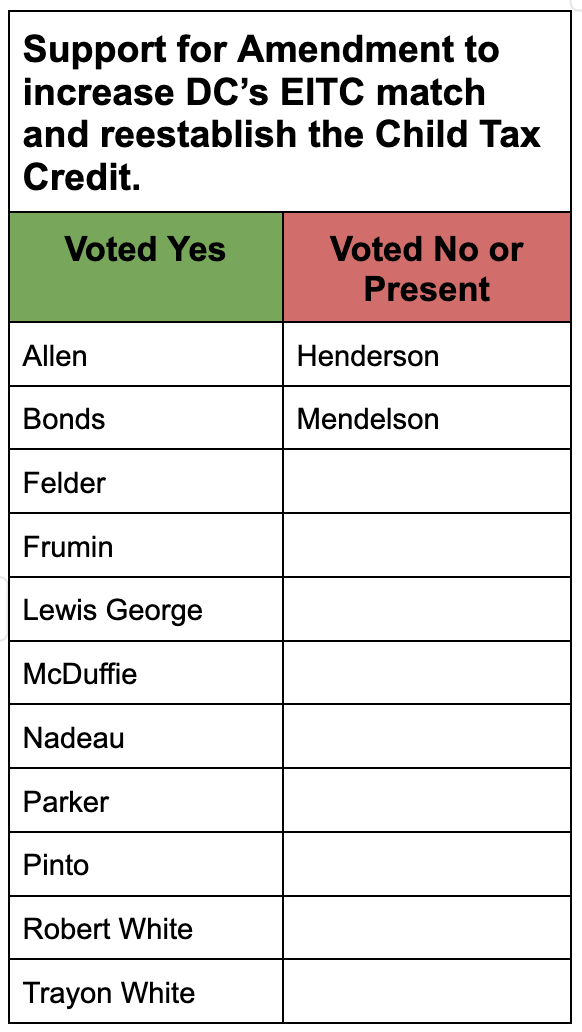
Did they support the amendment to the D.C. Income and Franchise Tax Conformity and Revision Emergency Amendment Act of 2025 that increased DC’s EITC match and reestablish the child tax credit? The underlying legislation saved the District $670 million between FY25 and FY29, through rejecting DC tax cuts that were triggered by the 2025 federal tax cut legislation. The amendment invests some of that revenue in District residents by making additional tax code reforms, including (1) moving forward the District’s 100% match of federal earned income tax credits to tax year 2025; and (2) reestablishing a District child tax credit starting in tax year 2026. The scoring below reflects those council members who voted for the amendment and those who did not.
DC for Democracy supports the amendment.