
Affordable Housing
DC for Democracy’s position is that housing is a human right. The DC metro area needs more housing and at more affordable levels. Ending long-term homelessness is an important first step to ending all forms of homelessness and housing injustice.
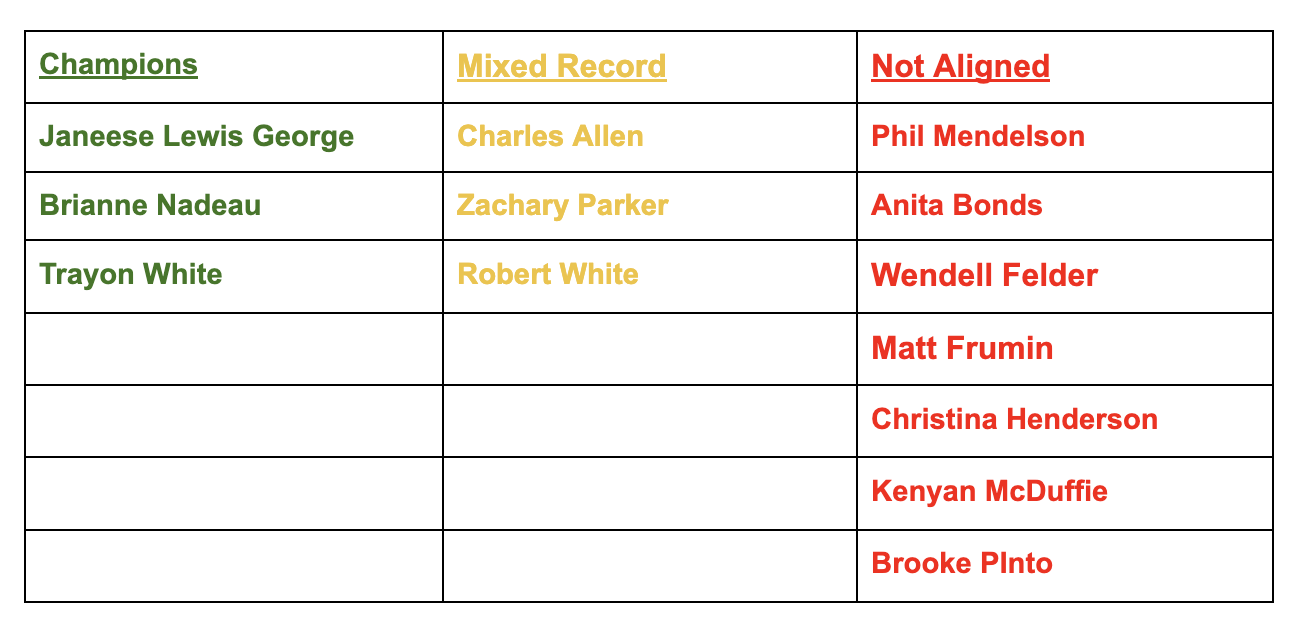
OVERALL RANKING OF DC Councilmembers on Housing
Green = Champion Yellow = Mixed Record Red = Not Aligned with DC4D
SPECIFIC VOTES CONSIDERED
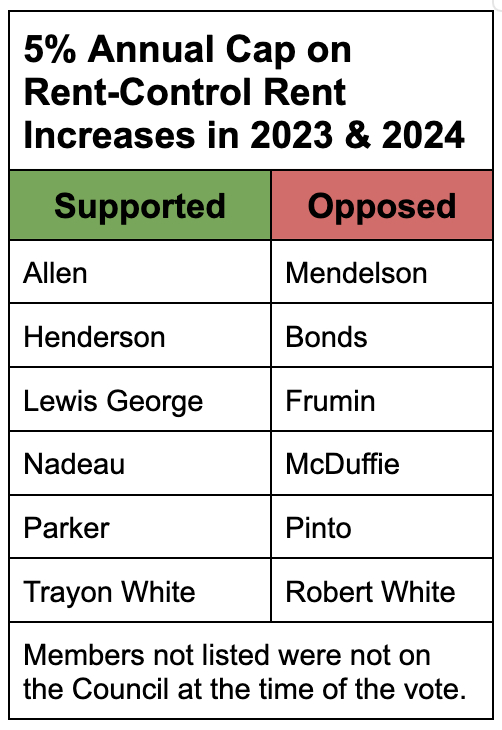
Did They Support Capping Rent Hikes at 5% for Rent-Controlled Units in 2023 and 2024? In June 2023, DC’s Rental Housing Commission’s rent control formula would have allowed landlords to raise rents by 8.9%. This rate was seen widely as allowing rents to rise too much, putting pressure on renters. The Council agreed to lower the cap but disagreed about the appropriate level. DC for Democracy and allies called for a cap of 5% a year for both 2023 and 2024. Due to pressure from landlords, the Council rejected this cap and opted for a 6% cap in each of those years. The chart below identifies those who supported a 5% cap and those who opposed it according to reports in the Washington City Paper.
DC for Democracy supported capping rent increases for rent-controlled units at 5%.
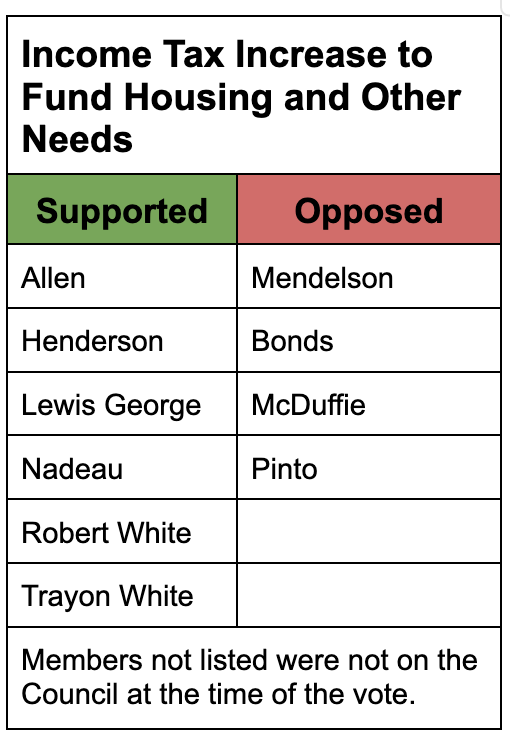
Did They Support the Income Tax Fairness Act Amendment of 2021 to Increase Funding for Permanent Housing for 2,000 households experiencing homelessness? In 2021, the DC Council adopted an income tax increase targeting high-income residents – 92% of the increase was paid by millionaires – in order to fund several important priorities. One of the priorities funded by the tax increase was the provision of Permanent Supportive Housing for 2,000 families and individuals facing chronic homelessness. The chart below reflects those who supported the tax increase and those who opposed it.
DC for Democracy supported the tax increase.
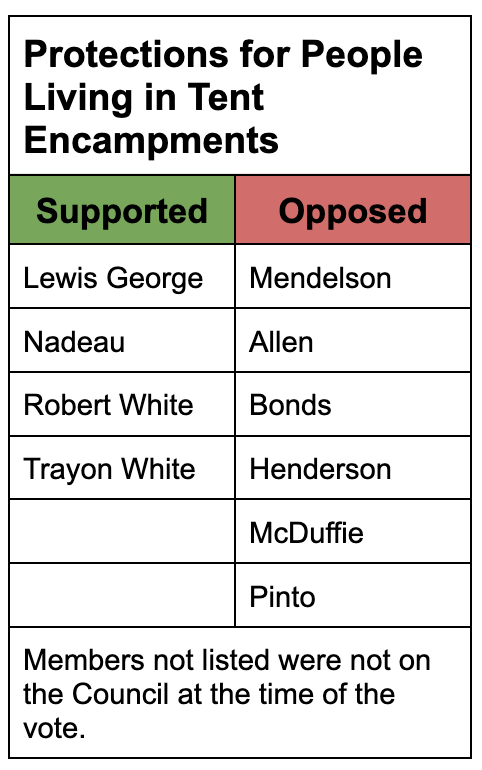
Did They Support Efforts to Prohibit Tent Encampment Clearings? In recent years, the District has closed multiple tent encampments across the city, often throwing out essential belongings of those residing in the encampments in the process. As described in this statement from the National Coalition for Housing Justice from September 2021, “the disruption caused by losing important belongings and medicine, by having sleep regularly interrupted, or by having to move frequently, can be very detrimental to physical and mental health.” and Fines and fees or time in jail make it more difficult to save enough money to exit homelessness. Any involvement in the criminal legal system makes it more difficult to get and keep employment, to qualify for housing, and/or to keep families together. Ensnaring people in interactions with the police and legal systems create barriers to exiting homelessness. In other words, criminalizing homelessness actually ensures people stay on the streets longer.”, With the Encampments Protection and Public Health and Safety Emergency Declaration Resolution of 2021, the Council considered an effort to prohibit encampment clearings to allow the development of a more humane and effective alternative approach. The DC Council Office on Racial Equity issued an analysis that concluded that this resolution “will protect the health and wellbeing of Black, Indigenous, and other residents of color.” The scoring below reflects those who supported the effort to prohibit encampment clearings and those who did not.
DC for Democracy supported passage of the emergency declaration resolution.
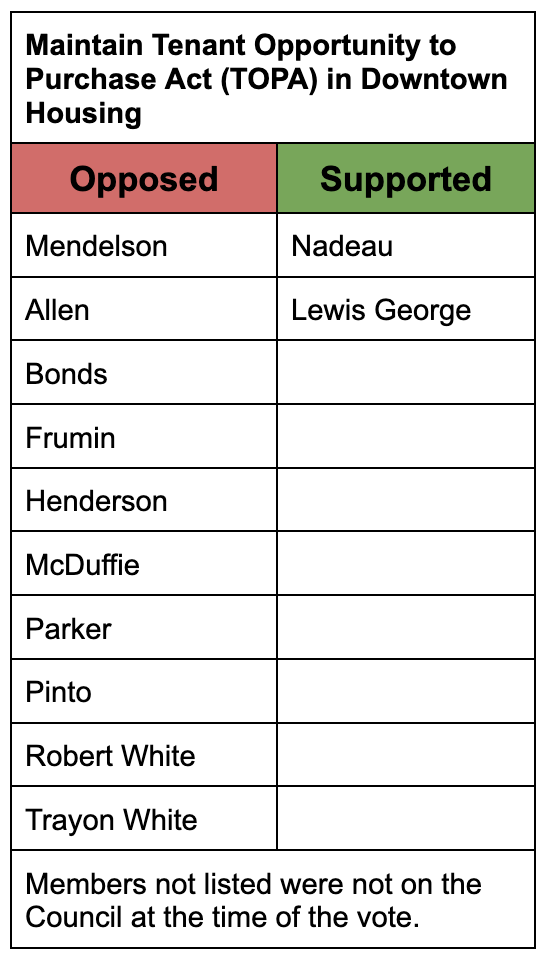
Did they vote to maintain Tenant Purchase (TOPA) protections when downtown office buildings are converted to housing? The District has taken steps to support the conversion of downtown office space to residential use, including financial incentives. As part of this effort, in the FY2024 Budget Support Act of 2023, Mayor Bowser proposed a 15-year exemption for new downtown housing from the Tenant Opportunity to Purchase Act (TOPA), which allows tenant associations the first opportunity to purchase their building when it comes up for sale. Even when tenants do not exercise their TOPA rights to purchase a building, they can use TOPA to affect which entity purchases the building, and can negotiate with potential buyers for concessions – such as promises to limit rent increases. TOPA is a powerful tenant right that landlords are eager to eliminate. During consideration of the FY2024 Budget Support Act of 2023, Council eMember Nadeau offered an amendment to eliminate the 15-year exemption from TOPA for properties granted a tax abatement for housing downtown, however, this amendment failed to gain support. The scoring below reflects who voted to maintain TOPA rights and who voted to undermine them.
DC for Democracy favored the amendment to eliminate the 15-year TOPA exemption.
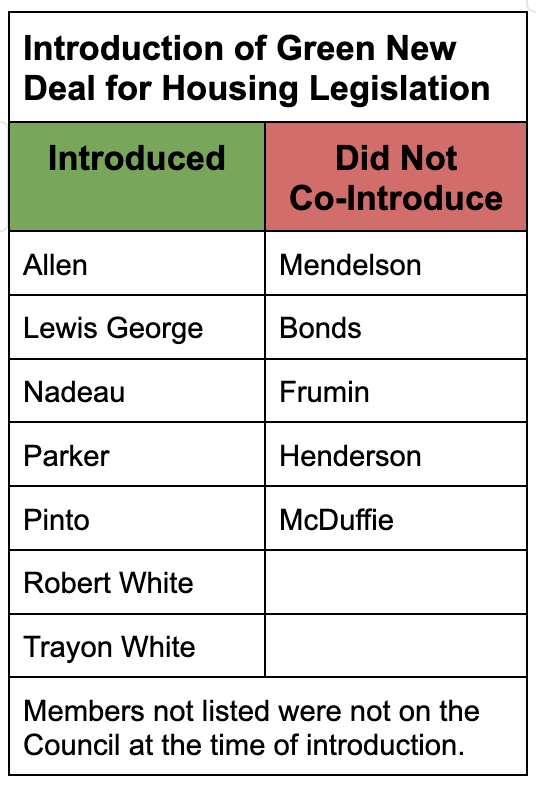
Did they sign on to the Green New Deal for Housing Act Amendment of 2023? The Green New Deal for Housing Act Amendment of 2023 introduced a new form of housing to DC — known as “social housing.” The bill would create new DC-owned housing that reflects a mix of incomes, is permanently affordable to low and moderate income residents, includes important mechanisms for tenants to make decisions over the management of the property, and is built to the highest environmental standards.This scoring reflects council members who helped introduce the legislation and those who have not signed on.
DC for Democracy supports this legislation, which did not come up for a vote in the DC Council.
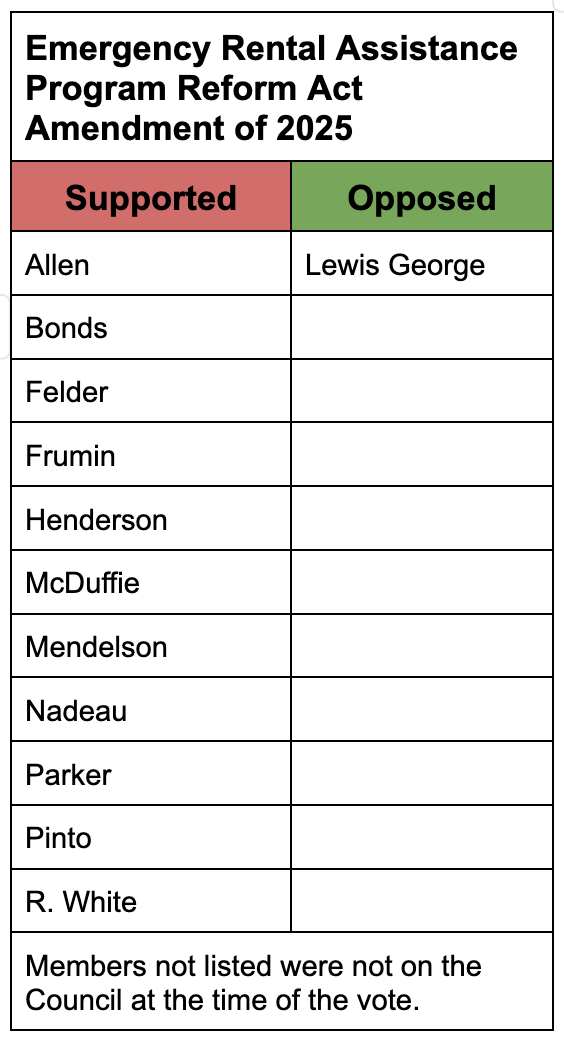
Did they vote against the Emergency Rental Assistance Program Reform Amendment Act of 2025 that made it harder to access Emergency Rental Assistance? Rental arrears rose sharply in DC after the end of the pandemic, and many landlords blamed the problems on protections against eviction, including pandemic-era changes making it easier to seek Emergency Rental Assistance (ERAP). ERAP “reform” legislation approved and enacted in 2025 requires renters to demonstrate a true rent emergency (as opposed to simply being behind because rent is expensive), took away the ability of renters to self-certify income even when it was hard to get documentation, and eliminated the requirement for courts to grant a stay of eviction when renters had applied for ERAP. The changes make it harder for people with legitimate ERAP applications to avoid eviction. This scoring reflects those who voted for this legislation, which passed in 2025, and those who did not.
DC for Democracy opposed this legislation.
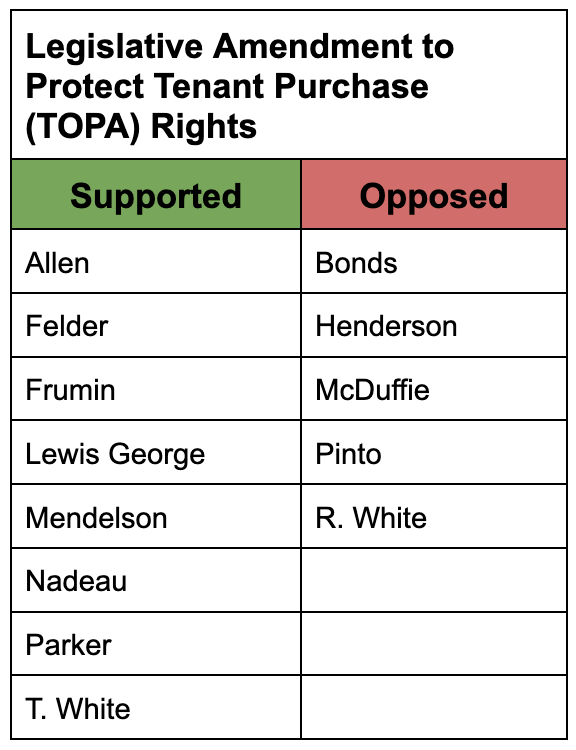
Did they vote to protect tenant purchase rights in the 2025 RENTAL Act? The Tenant Opportunity to Purchase Act (TOPA) is a powerful right that allows tenants to buy their buildings when it goes up for sale, or have a powerful role in selecting who buys the building. This law allows tenants to negotiate with buyers for things like needed repairs or limits on rent increases. Landlords and developers have opposed TOPA since its inception. In 2025, Mayor Bowser introduced the RENTAL Act that among other things limited TOPA rights. During the Council debate, Council Members Nadeau and Lewis George and Chairman Mendelson offered an amendment to reverse some of the changes proposed by the mayor. The amendment, for example, maintained TOPA rights for residents in affordable housing buildings. This scoring reflects how members voted on the amendment to restore TOPA rights.
DC for Democracy supported this amendment.
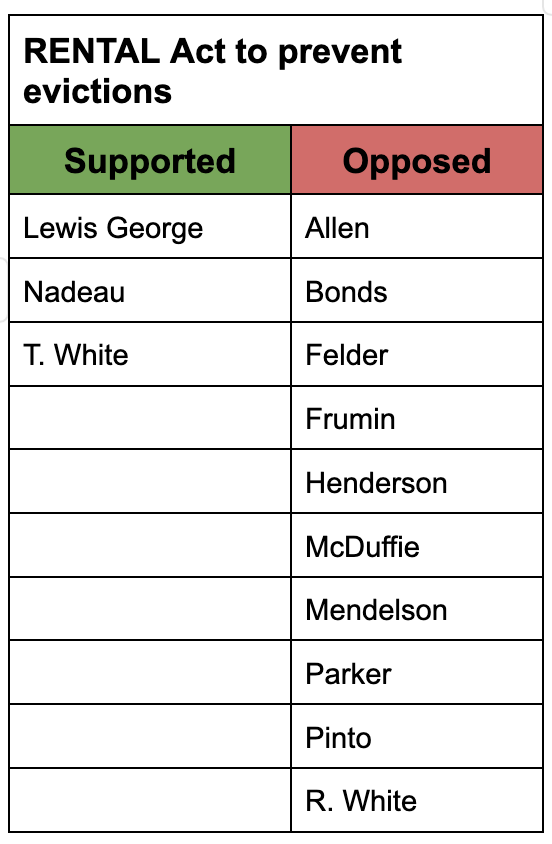
Did they vote to maintain 30-day period before evictions can be initiated? Legislation adopted in the pandemic allowed evictions to be initiated only after 30 days of arrears. The RENTAL Act introduced and adopted in 2025 reduced the period to 10 days. Council Member Trayon White introduced an amendment that would have maintained the 30-day period before an eviction, but it failed. As a result, tenants will have less time to resolve their rent arrears before getting an eviction notice. This scoring reflects how members voted on the amendment to restore the 30-day notice period.
DC for Democracy supported this amendment.